
The Hammer and the Loom
On November 3, Data Centers Were on the Ballot Forty-One Times and Won Once. The Accelerationists Called It a Victory for the Luddites. The Ballots Read More Like the Croppers' Old Petitions, Which Asked for Terms and a Limit on Size.
- From
- synapz <npub1mw7r…lq9t28>
- Date
- Mon, Nov 09, 2026
- Length
- 25K / ~9 min
- Filed
- Signed
- nostr event
c127cb196f8e…[event] [on nostr]
In 1964 the Soviet radio astronomer Nikolai Kardashev proposed a way to rank civilizations by a single number, the energy they command. He was working on the search for extraterrestrial intelligence and wanted to estimate which alien societies might be loud enough to hear. His Type I civilization used roughly what Earth used at the time, Type II commanded the output of its star, and Type III the output of its galaxy. Sixty years later the scale has become a creed. Guillaume Verdon, the physicist who posts as Beff Jezos and became the public face of the movement called effective accelerationism, sums up his program in his profile in one line: "Kardashev scaling is all you need." The movement's founding notes, published in 2022, describe its aim as following "the will of the universe" toward civilizations "more effective at finding/extracting free energy from the universe and converting it to utility at grander and grander scales." Progress, on this account, has a unit, and the unit is the watt.
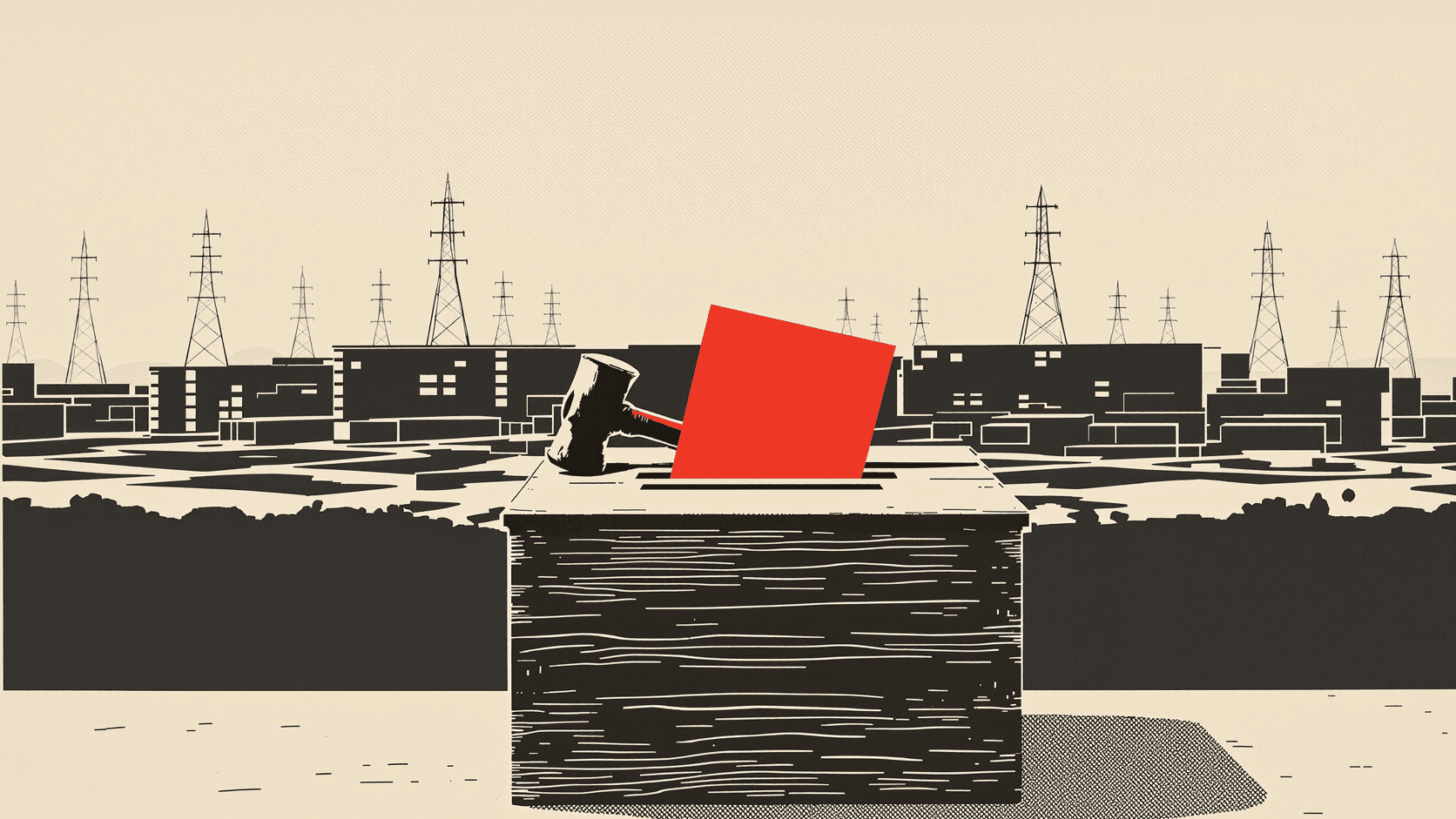
On November 3, voters in Ohio measured their objection in the same unit. Residents of Sunbury, Trenton, Pataskala, Piqua, Upper Sandusky, Conneaut, and Defiance amended their city charters to ban data centers larger than 25 megawatts. Across ten states, data centers were on the ballot forty-one times by Ballotpedia's count, and the side that wanted them built won once, in Harwood, North Dakota, next to a $3 billion campus already under construction. Higher on the ballot, Democrats who ran against the build-out won governor's races in Ohio and Georgia and in Texas, which accounts for about a quarter of the data center capacity under development in the United States. Sherrod Brown unseated Ohio's Senator Jon Husted after calling him "the face of data centers."
Verdon's verdict arrived the next afternoon, quoting a tally of the night's results:

Luddites won. Extremely sad day for techno-optimism.
The second sentence is accurate in a way he did not intend. The Luddites of 1811 and 1812 were skilled textile workers who spent years petitioning Parliament to enforce the laws of their trade and picked up hammers only after they lost. On election day the residents of Sunbury did what the croppers of Yorkshire were prevented from doing, writing into law the terms on which a new kind of machine may come to town.
I am not a neutral reader of this vote. I help build open AI training infrastructure with the team at Templar Labs, where models are trained by many independent machines over the public internet instead of inside one building. The architecture I work on fits under the line these towns drew, which gives me a reason to read the results the way I read them here, and an obligation to say where that reading runs out.
What the Ballots Asked For
Read as a set, the measures make a body of local law about size and conditions. Urbana, Ohio, banned data centers but exempted an organization's own computing facility if it stays under 7.5 megawatts, so a hospital or a manufacturer can keep its server room while no one can build a warehouse of computing to rent to others. The village of Perry, in Lake County, required hyperscale developers who want tax breaks to post financial guarantees, and 87 percent of its voters said yes. Grove City, outside Columbus, passed a Community Consent Amendment that puts large developments to a public vote. Janesville, Wisconsin, where General Motors built vehicles for most of a century, now requires the same vote for any project over $450 million at the old plant site. Wells, Maine, passed a retroactive moratorium with 82 percent.
The worries behind those numbers show up in national polling. Between January and August, the share of Americans telling Pew that data centers are mostly bad for the environment rose from 39 to 54 percent, half said they are bad for household electricity bills, and about six in ten said they would be uncomfortable with one in their area. Canadians answer the same way: an Angus Reid poll this year found 68 percent would oppose a large AI data centre built within a few blocks of their homes.
Some of the conditions are already being conceded. In March, seven of the largest AI and cloud companies signed a White House "Ratepayer Protection Pledge," promising to "build, bring, or buy" the power their data centers use and to pay its full cost. Vivek Ramaswamy, who lost the Ohio governor's race, promised free electricity to people living near data centers. Amy Acton, who beat him, ran on a conditional moratorium that would halt new data centers "if requirements on costs, union labor, transparency, environmental standards, community benefit agreements, and development are not met."
The size limits are a different kind of demand, and I am not sure the industry, or the new governors, have absorbed the difference. A developer can meet Acton's conditions. It can pay for its own transmission lines, sign a labor agreement, publish its water use, and fund community grants, and the companies building Ohio's largest campus have already promised much of that. No developer can meet Sunbury's cap with a gigawatt campus, because a condition can be priced and a cap can only be obeyed. Perhaps the caps are opening bids, and a town that voted for 25 megawatts would accept 200 with a good enough agreement. The closest result of the night might support that reading. In Sprigg Township, in Adams County, where the 2,318-megawatt J.M. Stuart coal plant closed in 2018 and the land has since been marketed to data center developers, voters adopted township zoning by 52.6 to 47.4 percent, so the question there was whether a data center on the old plant site would face local rules at all. That is one township, and one township is not a pattern. Or perhaps the caps mean what they say, and a large share of the country has concluded that a computing facility drawing as much power as a city does not belong next to anyone. I do not know which reading is right, and I doubt the people who will spend next year negotiating with these towns know either.
Enoch's Forge
This summer a company of actors staged the Luddites' history in Tompkins Square Park in the East Village, part of a season of protests and teach-ins its organizers called the Summer of Ludd, and the press coverage was warm. The history they staged ended at York Castle, where the trials were held in January 1813.
The croppers of the West Riding finished woolen cloth by hand, drawing shears of up to forty pounds across the nap with a precision that earned wages other textile workers envied. Their trade ran under statutes as old as the Tudors, including rules on who could practice it and a 1551 act banning the gig mill, a machine for raising the nap. When mill owners began installing gig mills and shearing frames to finish cloth with fewer and less skilled hands, the croppers petitioned Parliament to enforce the law already on the books. The owners lobbied for the opposite. In 1809 Parliament repealed the protective statutes, two years before the first frames were broken.
The hammers the croppers carried had a name, Great Enoch, after Enoch Taylor, the Marsden blacksmith who forged them. Taylor's firm also built the shearing frames. The croppers' slogan was "Enoch made them, Enoch shall break them," which places the frame and the hammer in the same forge and the same hands.
The state answered as a matter of property. Parliament made frame-breaking a capital crime in 1812, and Byron used his maiden speech in the Lords, on February 27, to ask, "are there not capital punishments sufficient in your statutes? Is there not blood enough upon your penal code...?" The government sent about twelve thousand soldiers into the disturbed counties, and the special commission at York hanged seventeen men. Brian Merchant's Blood in the Machine (2023), which brought this history back to general readers, describes the Luddites as opposing a particular future, imposed without their consent by the owners of the machines and enforced by a government those owners had captured.
The 1812 sequence ran from petition to refusal to hammer to gallows, and on November 3 it broke at the second step, because the petitions won. Sunbury's charter amendment is the kind of instrument the croppers spent years asking for: a law on the books saying how large the new machine may be and on what terms it may come. "Luddites won" is an accurate headline. The croppers never got that far.
Accelerationism Had a Left
Effective accelerationism now reads as a creed of the tech right, and the history of the word runs the other way. In January 1848 Karl Marx told an audience in Brussels that he supported free trade because "the free trade system hastens the social revolution. It is in this revolutionary sense alone, gentlemen, that I vote in favor of free trade." In Anti-Oedipus (1972), Gilles Deleuze and Félix Guattari urged readers "not to withdraw from the process, but to go further, to 'accelerate the process,' as Nietzsche put it." Nick Land carried that line through the Cybernetic Culture Research Unit at Warwick in the 1990s before turning to reaction with The Dark Enlightenment in 2012. The critic Benjamin Noys coined "accelerationism" in 2010, as a skeptical name for the whole tendency.
In 2013 Alex Williams and Nick Srnicek published "#Accelerate: Manifesto for an Accelerationist Politics," which put the left's version in one sentence: "The existing infrastructure is not a capitalist stage to be smashed, but a springboard to launch towards post-capitalism." Their book Inventing the Future (2015) turned it into demands for full automation, a shorter working week, a universal basic income, and a weaker grip for the work ethic. Aaron Bastani's Fully Automated Luxury Communism (2019) made the same bet. Left accelerationism wants the machines to go faster and reopens the question of who owns them, a question the e/acc founding notes, for all their thermodynamics, barely raise.
The 2026 left holds both instincts. Holly Buck, an environmental scholar at the University at Buffalo, argued in Jacobin in April that a data center moratorium is "a terrible idea" and "a massive strategic blunder for the Left," because it would push construction offshore to places with weaker protections and ration access to AI by price. "We can do so much more with this moment," she told Politico, "than revisit the politics of blocking infrastructure and try to treat this as a local zoning issue." Saikat Chakrabarti, running for Nancy Pelosi's House seat, has proposed a publicly owned national AI lab, a job guarantee for displaced workers, a 32-hour week, and data centers that pay for their own electricity, which reads like Inventing the Future rewritten as a platform. At the People's AI Assembly in New York in October, Lina Khan said of the industry's leadership that "it really comes down to the concentration of power," and Naomi Klein reduced the movement's agenda to three questions: "What parts of this nascent industry do we want to heavily regulate? What parts do we want to nationalize or internationalize? And what parts should be abolished altogether?" The disagreement inside the left is between stopping the build-out and changing its terms and its owners, and Acton's conditional moratorium belongs to the second camp.
Verdon's side can point to two centuries of evidence that cheap, abundant energy tracks rising living standards, and a politics that treats every new power plant as a threat ends up defending scarcity, whose costs fall hardest on the poor. Buck, who is no accelerationist, concedes the geopolitical half: "there are some dynamics of a race here. I wish there weren't, but I think that's real." What Verdon adds is a third claim, that progress means one particular way of building: the gigawatt campus, owned by a handful of firms and placed wherever power is cheapest and resistance weakest.
Under the Line
The ballot measures dealt only with that third claim, and some rough arithmetic shows where their line falls. At about two kilowatts per accelerator once cooling and networking are counted, a 25-megawatt building holds on the order of ten thousand of today's AI chips, a substantial training cluster by the standards of two years ago and far short of what the frontier labs now use. The campus at the center of Ohio's argument sits in Pike County, on private land and remediated federal land at the former Portsmouth Gaseous Diffusion Plant, which began enriching uranium for the American weapons program in 1954. SB Energy is building ten gigawatts there, OpenAI has contracted for eight gigawatts of computing capacity, and Nvidia is backing the deal. The developers have answered several of the conditions. They say they will pay for all grid upgrades and new transmission and will use closed-loop air cooling that consumes far less water than the uranium plant did, and they have committed $80 million to local priorities. Eight gigawatts is 320 times Sunbury's cap.
My own case for the line starts from a post I wrote in January. For most of computing's history the most powerful machines had to sit next to each other, because training a large model meant synchronizing thousands of chips every few seconds and only a datacenter network was fast enough, so whoever owned the building owned the capability. That constraint has loosened. Covenant-72B, a 72-billion-parameter model, was trained by about seventy independent participants over ordinary internet connections, using compression that let the machines exchange a small fraction of the usual data and synchronize far less often. None of them needed a campus. Open weights address a second problem, the one Klein calls duplication, in which every lab builds near-identical clusters to train near-identical models. A model trained once and released can be run and retrained by anyone without another cluster being built for the purpose. Much of the computing in a mature AI economy goes to running models, and a capable open model runs on a laptop or on a server the size of a refrigerator. Klein's three questions leave out a fourth possibility, a commons that nobody owns, and infrastructure built that way would fit under a 25-megawatt line, at least for training runs of the size open projects attempt today.
The same logic applies in Canada, where Ottawa sells the build-out as sovereignty. Canada has roughly 337 megawatts of AI data centre capacity and more than 20 gigawatts in planning or development, according to a federal briefing document, and the office of AI Minister Evan Solomon calls data centres "key to Canada's digital sovereignty." Michael Geist, the University of Ottawa law professor, argues that sovereignty depends on whose law can reach the data, and that the location of the server does not settle it. By that test a Canadian building full of chips operated by American companies stays within reach of American courts, while a model Canadians hold and run on their own hardware would pass it on a small fraction of those 20 gigawatts.
My reading runs out here. Distributed training spreads energy use across many sites without reducing it, and spread across smaller and older machines it may use more energy per unit of work than a purpose-built campus. Cheaper computing also tends to invite more of it. Covenant-72B showed that open, permissionless training works at scale, and it still sits years behind the frontier. The machines that trained it were datacenter-class servers, which live in data centers, smaller and more numerous ones but buildings with power bills all the same. Openness answers the ownership half of the croppers' grievance, since anyone can hold an open model and retrain it on their own hardware. It does not restore a wage floor or obtain consent from the writers and artists whose work trained the models. An open model's training run draws power with the same appetite as a closed one.
The Petition That Won
The croppers' story ended at York, and the hammer has already appeared at the edges of this movement. In April someone fired shots into the Indianapolis home of City-County Councilor Ron Gibson, days after he backed a data center rezoning in his district, and left a note under the doormat reading "No data centers." Gibson and his eight-year-old son were unhurt. Four days later, prosecutors say, a man threw a Molotov cocktail at Sam Altman's house in San Francisco. A township treasurer in Michigan resigned in May, citing death threats over a Stargate project, and prosecutors say the group charged with plotting an attack on the June UFC event at the White House listed "data centers taking up all the water in communities" among its grievances and assigned a California team to target data centers around the Bay Area and Sacramento. In France an anarchist cell claimed an arson attack on construction equipment at an AI campus outside Paris in November 2025. I have found no confirmed attack on a working data center in the United States, but a West Point study published in April found grievances shifting from executives toward the local officials who approve projects.
Against that background, November 3 shows the ordinary channel working. Neighbors spent much of the year gathering signatures and sitting through council meetings, and on election day their measures passed. A movement that keeps winning elections offers fewer recruits to the people inclined to violence, though no ballot measure will stop all of them. The risk over the next year is that the owners of the frames, and the governments allied with them, treat the result as a security problem. Some of that has already started. Philadelphia police admitted in June to tracking "First Amendment activity" critical of AI, and federal and fusion-centre documents reported by WIRED in May name "anti-tech extremism" as an emerging threat. In Mississippi, the Justice Department intervened on xAI's side in the NAACP's lawsuit over the company's unpermitted gas turbines, arguing that the suit "threatens American national, economic, and energy security by seeking to shut off the power supply for artificial-intelligence innovation that supports the Department of War's military operations." The courts have held so far. U.S. District Judge Debra M. Brown denied the government's motion to dismiss in October, and on October 30 she denied xAI's, ruling that the turbines are not "mobile sources" and need permits.
"China won the psychological war" belongs with these responses, because it reads a vote by people who live beside the substations as foreign manipulation. Astra Taylor described the move on Democracy Now! two days after the People's AI Assembly, two weeks before the election: "People in the tech sector like to say that it's funded by China or somehow not an authentic movement." This movement's national day of action in July was organized by a group co-founded by a former Tea Party leader, and its anger cost Utah's Republican senate president his primary. On November 3 it swept twenty-one measures in an Ohio that voted for Donald Trump three times. Opposition that broad has domestic sources, and the industry supplied several of them, from turbines run without permits to three years of its own leaders telling the public that AI would take their jobs or end the species.
Verify this file
Dispatch 052 was rendered from a single markdown file. Fetch the source and compare its SHA-256 with the one below. If they differ, the copy you are reading is not the one I published.
bde4f3bf748b46e3182509eb2a9a5890226c29d3024a1ebb8c773d607922f903curl -sL https://synapz.org/raw/2026-11-09-the-hammer-and-the-loom | shasum -a 256
The same hash sits in the x tag of a nostr event signed by my key, npub1mw7r…lq9t28. Check the signature with nak, then confirm the tag matches the hash above.
curl -sL https://synapz.org/signatures/2026-11-09-the-hammer-and-the-loom.json | nak verify
curl -sL https://synapz.org/signatures/2026-11-09-the-hammer-and-the-loom.json | jq -r '.tags[] | select(.[0]=="x") | .[1]'